Health and Safety Policy — Office Clearance Hackney
Our company is committed to maintaining a safe, healthy and compliant environment for staff, clients and the public during all office clearance and rubbish removal activities. This policy sets out the standards, responsibilities and control measures we apply across commercial clearance projects and office waste removal operations. It applies to every team member, contractor and temporary worker engaged in clearing, transporting and disposing of office debris, furniture and associated refuse. The aims are to prevent injury, avoid environmental harm and ensure consistent safe practice.
All employees have a responsibility to follow safe working practices, use provided protective equipment and report hazards promptly. Managers and supervisors must ensure risk assessments are carried out, controls are implemented and staff receive appropriate instruction and supervision. The appointed safety lead will coordinate training, maintain records and monitor compliance with this office clearance safety policy. Contractors engaged for rubbish collection and bulky removal must demonstrate safe systems, suitable insurance and cooperation with site-specific requirements before work begins.

Risk assessment and control measures
Primary hazards include manual handling, slips trips and falls, sharp objects, hazardous materials from electronic waste, awkward lifting, vehicle movements and congestion in confined workspaces. Our risk assessments identify likelihood and severity and prescribe elimination, substitution, engineering and administrative controls. Key measures include clear signage, exclusion zones, safe lifting techniques, mechanical handling aids and secure loading of vehicles. Personal protective equipment is provided and must be used where controls do not fully eliminate risk. Emergency access and egress routes must remain unobstructed at all times.
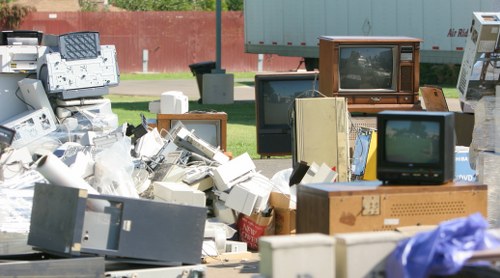
Before any clearance begins a documented method statement is prepared for each site and task. This will describe the sequence of work, required equipment, permit needs and assigned responsibilities. Hazardous items such as batteries, toner cartridges, chemicals and asbestos suspect materials are segregated and handled in accordance with specialist procedures. Where removal of suspect asbestos or other regulated waste is necessary, licensed specialists are engaged and works are coordinated to protect workers and the public. Vehicles used for removal are inspected daily and maintained to safe operating standards.

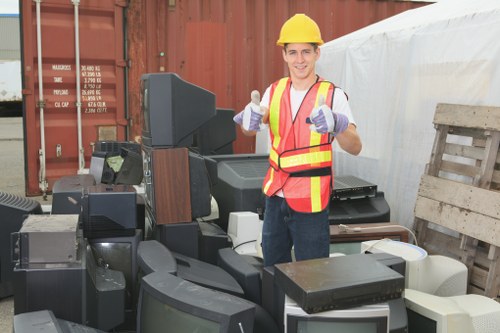
Training, competence and equipment are central to our approach. Employees receive induction training, practical instruction in manual handling techniques and specific guidance on mechanical aids and vehicle safety. Refresher sessions are scheduled regularly and records of completion are kept. The use of appropriate gloves, eye protection, hi-visibility clothing and sturdy footwear is mandatory where tasks present a risk. Specialist lifting equipment and trolleys are provided and inspected; any defective tools are removed from service until repaired or replaced to prevent incidents.
Reporting and investigation of incidents and near misses is mandatory. All occurrences are recorded, investigated and where necessary changes are made to prevent recurrence. First aid provision is assessed for each project and trained first aiders are available on site or nearby. Where injuries occur, prompt medical attention is arranged and the event is reviewed to identify lessons. Contractors must report any property damage, vehicle incidents or environmental spills immediately and assist in remedial measures and investigation.
Waste handling and segregation are integral to our duty of care. Recyclable materials, confidential documents and hazardous components are separated at source and processed according to best practice. Confidential waste is handled with secure containment and documented chain of custody to protect client information. Bulky items are assessed for reuse or donation where safe to do so, reducing landfill and supporting sustainable clearance services. Load security, correct weight distribution and vehicle coverings are applied to prevent spillage during transit.
Inspections, audits and continuous improvement
Regular site inspections, vehicle checks and toolbox talks ensure standards are maintained and improvements are identified. Audits are conducted internally and by third parties where required to confirm compliance with this office clearance safety policy and industry expectations for rubbish removal teams. Corrective actions are prioritised and tracked until closed. We encourage staff to suggest improvements and to report unsafe practices; proactive engagement supports a culture of safety and continual improvement across all clearance operations.
Emergency preparedness and review mechanisms are essential. All team members must know the emergency contact procedures, evacuation assembly points and how to secure a site in the event of fire, spill or other incident. The policy emphasises that safety is a shared responsibility: management will provide leadership and workers must follow procedures and report hazards. Key responsibilities include:
- Management: ensure resources, oversight and timely response to incidents.
- Supervisors: maintain safe systems, conduct briefings and monitor compliance.
- Employees: follow instructions, use PPE and stop work where safety is compromised.
All records, incident reports and training logs are retained and reviewed periodically. The policy will be reviewed annually or after significant events to ensure it remains effective, easily understood and aligned with best practice for office and commercial clearance services. This statement is endorsed by senior leadership and forms the basis of our operational safety approach. This policy supports safe, sustainable and reliable clearance operations.
